Showing posts with label Politics. Show all posts
Showing posts with label Politics. Show all posts
30 January 2009
Represent
And you thought all New Hampshire had to offer was a broken man in the mountain.
And no sales tax.

22 January 2009
A Thousand Words
Check out the work of Pete Souza, the former Chicago Tribune national photographer who has now been named Obama's White House photographer. Souza's photos from Obama's first year as Illinois senator have been compiled into the book, The Rise of Barack Obama, which contains some truly telling images.
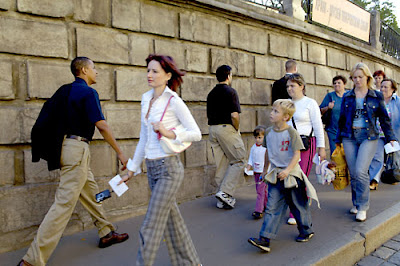 Obama in Moscow
(Tribune photo by Pete Souza / August 25, 2005)
Few recognized Barack Obama as he walked on a sidewalk in Moscow in 2005.
 Kenya tradition
(Tribune photo by Pete Souza / August 26, 2006)
Sen. Barack Obama dances with one of the grandmothers who care for orphaned grandchildren at a CARE project that he partially funded in Siaya, Kenya.
 Candidate's wife
(Tribune photo by Pete Souza / February 10, 2007)
Michelle Obama brushes off her husband's coat inside the Old State Capitol in Springfield in February just before he proceeded into the chilly winter air to announce his entrance into the presidential race.
Photos and captions taken from chicagotribune.com
 Obama in Moscow
(Tribune photo by Pete Souza / August 25, 2005)
Few recognized Barack Obama as he walked on a sidewalk in Moscow in 2005.
 Kenya tradition
(Tribune photo by Pete Souza / August 26, 2006)
Sen. Barack Obama dances with one of the grandmothers who care for orphaned grandchildren at a CARE project that he partially funded in Siaya, Kenya.
 Candidate's wife
(Tribune photo by Pete Souza / February 10, 2007)
Michelle Obama brushes off her husband's coat inside the Old State Capitol in Springfield in February just before he proceeded into the chilly winter air to announce his entrance into the presidential race.
Photos and captions taken from chicagotribune.com
21 January 2009
Imagine All The People
"For they [those who question the scale of our ambitions] have forgotten what this country has already done; what free men and women can achieve when imagination is joined to common purpose, and necessity to courage."
 This is my favorite part from Obama's inaugural speech. And not just because it celebrates the achievements of our country, but because of the calling it could become for the Church. What if the Church reawakened its Christian political imagination (not my words) and joined in its common purpose?
We have been reading the book, Jesus for President, with others from our church and it has been instrumental in provoking some good conversation, and I might even say, our imaginations. Do we have it all figured out? No way. But it's been a good place to start in rethinking how we live our lives, how the choices (small and large) we make reflect what we believe about the Christian life. Here is an excerpt of the book's description by Zondervan:
[For other reading on this topic, I strongly recommend The Myth of a Christian Nation by Greg Boyd.]
 This is my favorite part from Obama's inaugural speech. And not just because it celebrates the achievements of our country, but because of the calling it could become for the Church. What if the Church reawakened its Christian political imagination (not my words) and joined in its common purpose?
We have been reading the book, Jesus for President, with others from our church and it has been instrumental in provoking some good conversation, and I might even say, our imaginations. Do we have it all figured out? No way. But it's been a good place to start in rethinking how we live our lives, how the choices (small and large) we make reflect what we believe about the Christian life. Here is an excerpt of the book's description by Zondervan:
Jesus for President is a radical manifesto to awaken the Christian political imagination, reminding us that our ultimate hope lies not in partisan political options but in Jesus and the incarnation of the peculiar politic of the church as a people “set apart” from this world.Probably the best part about the book is that it provides practical examples and real stories of how this is being lived out today, and reminders of how this has been lived out in the past (ie: Dr. King, Bonhoeffer, Romero). I find it important to acknowledge that while this book has most definitely been written in a certain context (ie: 2008 America), it emphasizes that this "new" movement is really part of a bigger, pre-existing and ongoing story, and is therefore not new at all. Rather, it is a reminder of what has occurred when imagination has been joined to common purpose, and a recall of Christians to that alternate way of life.
[For other reading on this topic, I strongly recommend The Myth of a Christian Nation by Greg Boyd.]
19 January 2009
Remembering
In preparation for our small group meeting tonight, I had a chance to reread some of the speeches and writings of Dr. Martin Luther King, Jr. I wondered why I don't do that more often, but I'm glad I did today. These words are no less relevant 50+ years later, even on the heels of an historical inauguration.
True peace is not merely the absence of some negative force - tension, confusion, or war; it is the presence of some positive force - justice, good will and brotherhood.
Dr. King's address before the First Annual Institute on Non-Violence and Social Change, Montgomery, AL, December 1956
Any religion that professes to be concerned about the souls of men and is not concerned about the slums that damn them, the economic conditions that strangle them and the social conditions that cripple them is a spiritually moribund religion awaiting burial.
From an article appearing in the magazine Christian Century, 1960
I have almost reached the regrettable conclusion that the Negro's great stumbling block in the stride toward freedom is not the White Citizens Counciler or the Ku Klux Klanner, but the white moderate who is more devoted to "order" than to justice; who prefers a negative peace which is the absence of tension to a positive peace which is the presence of justice; who constantly says, "I agree with you in the goal you seek, but I can't agree with your methods of direct action"; who paternalistically feels that he can set the timetable for another man's freedom; who lives by the myth of time and who constantly advised the Negro to wait until a "more convenient season." Shallow understanding from people of good will is more frustrating than absolute misunderstanding from people of ill will. Lukewarm acceptance is much more bewildering than outright rejection.
Letter from a Birmingham Jail, 1963
07 November 2008
An Exhortation
I would assume that regardless of who you voted for, it is hard not to bask in the historical significance of Tuesday's election. It is good and right and necessary to acknowledge and celebrate what this means for us, as a country and as individuals. I feel that we have somewhat redeemed ourselves in eyes of the world, but more importantly, we can once again believe in our collective conscience. Our country needed this. Our history needed this. Our souls needed this.
I would also assume that it is not enough to just have a black president, but rather, we need a successful black president. And I believe Obama earned this, winning not because (or in spite of the fact) he is black, but because people believe in his vision, leadership and character. I am proud and relieved to know that we, as a nation, were able to rise to the occasion and make history.

I am certain, however, despite the proclamations of the media, that this does not mean that America has been born anew, cleansed from its legacy of racism. We have indeed dawned a new day, but we cannot forget the dark yesterdays and the ugly tomorrows to come. Because they will come. The two pronged attack of racism, the individual coupled with the systemic, is fierce, and even with an African-American in the White House, you can bet that racism will continue to plague our neighborhoods, our work places, our schools and even our homes. We must not rest, believing that the history and present reality of injustice has been rendered obsolete by an electoral map. There is still work to be done.
But for now, I am more than happy to raise a glass to Obama, to celebrate this moment and to look with promise to the future. I know that my hopes cannot be pinned to any president, this one or the next, but it sure helps to have one who stirs my soul.
I would also assume that it is not enough to just have a black president, but rather, we need a successful black president. And I believe Obama earned this, winning not because (or in spite of the fact) he is black, but because people believe in his vision, leadership and character. I am proud and relieved to know that we, as a nation, were able to rise to the occasion and make history.

I am certain, however, despite the proclamations of the media, that this does not mean that America has been born anew, cleansed from its legacy of racism. We have indeed dawned a new day, but we cannot forget the dark yesterdays and the ugly tomorrows to come. Because they will come. The two pronged attack of racism, the individual coupled with the systemic, is fierce, and even with an African-American in the White House, you can bet that racism will continue to plague our neighborhoods, our work places, our schools and even our homes. We must not rest, believing that the history and present reality of injustice has been rendered obsolete by an electoral map. There is still work to be done.
But for now, I am more than happy to raise a glass to Obama, to celebrate this moment and to look with promise to the future. I know that my hopes cannot be pinned to any president, this one or the next, but it sure helps to have one who stirs my soul.
03 October 2008
It's Not Just Me
 A Conservative for Obama
My party has slipped its moorings. It’s time for a true pragmatist to lead the country.
Leading Off By Wick Allison, Editor In Chief
THE MORE I LISTEN TO AND READ ABOUT “the most liberal member of the U.S. Senate,” the more I like him. Barack Obama strikes a chord with me like no political figure since Ronald Reagan. To explain why, I need to explain why I am a conservative and what it means to me.
In 1964, at the age of 16, I organized the Dallas County Youth for Goldwater. My senior thesis at the University of Texas was on the conservative intellectual revival in America. Twenty years later, I was invited by William F. Buckley Jr. to join the board of National Review. I later became its publisher.
Conservatism to me is less a political philosophy than a stance, a recognition of the fallibility of man and of man’s institutions. Conservatives respect the past not for its antiquity but because it represents, as G.K. Chesterton said, the democracy of the dead; it gives the benefit of the doubt to customs and laws tried and tested in the crucible of time. Conservatives are skeptical of abstract theories and utopian schemes, doubtful that government is wiser than its citizens, and always ready to test any political program against actual results.
Liberalism always seemed to me to be a system of “oughts.” We ought to do this or that because it’s the right thing to do, regardless of whether it works or not. It is a doctrine based on intentions, not results, on feeling good rather than doing good.
But today it is so-called conservatives who are cemented to political programs when they clearly don’t work. The Bush tax cuts—a solution for which there was no real problem and which he refused to end even when the nation went to war—led to huge deficit spending and a $3 trillion growth in the federal debt. Facing this, John McCain pumps his “conservative” credentials by proposing even bigger tax cuts. Meanwhile, a movement that once fought for limited government has presided over the greatest growth of government in our history. That is not conservatism; it is profligacy using conservatism as a mask.
Today it is conservatives, not liberals, who talk with alarming bellicosity about making the world “safe for democracy.” It is John McCain who says America’s job is to “defeat evil,” a theological expansion of the nation’s mission that would make George Washington cough out his wooden teeth.
This kind of conservatism, which is not conservative at all, has produced financial mismanagement, the waste of human lives, the loss of moral authority, and the wreckage of our economy that McCain now threatens to make worse.
Barack Obama is not my ideal candidate for president. (In fact, I made the maximum donation to John McCain during the primaries, when there was still hope he might come to his senses.) But I now see that Obama is almost the ideal candidate for this moment in American history. I disagree with him on many issues. But those don’t matter as much as what Obama offers, which is a deeply conservative view of the world. Nobody can read Obama’s books (which, it is worth noting, he wrote himself) or listen to him speak without realizing that this is a thoughtful, pragmatic, and prudent man. It gives me comfort just to think that after eight years of George W. Bush we will have a president who has actually read the Federalist Papers.
Most important, Obama will be a realist. I doubt he will taunt Russia, as McCain has, at the very moment when our national interest requires it as an ally. The crucial distinction in my mind is that, unlike John McCain, I am convinced he will not impulsively take us into another war unless American national interests are directly threatened.
“Every great cause,” Eric Hoffer wrote, “begins as a movement, becomes a business, and eventually degenerates into a racket.” As a cause, conservatism may be dead. But as a stance, as a way of making judgments in a complex and difficult world, I believe it is very much alive in the instincts and predispositions of a liberal named Barack Obama.
From D Magazine
30 September 2008
Beyond the Voices
 I told you that I'm embracing my swing voter status, but, until recently, it hasn't been all that easy. My conservative leanings relentlessly prod me toward McCain, but, to be honest, I'm not excited about him. At all. Not even with Palin, and partly because of her. My conservative side is saying don't get wrapped up in the drama of Obama. He's charismatic, compelling, resonating, but he still employs age-old liberal ideas (with a liberal voting record to prove it) that have not always been of benefit to our country. The conservative side of me says remember, remember. But my newly emerged, liberal nodding, independent side is saying forget, forget. Forget your old ways and embrace the new. Forget any sense of party allegiance, consider what is imperative for today, and for once in your political life, let your heart take over your head (it's hard for me to even write that). And the commanding, overarching, God-breathed whole of me is saying you are beholden to no party, candidate, president or nation. You play by a different set of rules altogether. Be shrewd. Be wise.
But now, the battle is behind me, and for the most part, the voices have been silenced, except for the last. I hear only the freedom (and responsibility) to seriously consider both candidates and vote for a leader fit to meet the challenges of today. The permission I have given myself to do this is liberating, and, unlike before, I'm ready to take on the next 35 days.
I'm back in the presidential race.
18 September 2008
On the Fence Independence
 Ok, here we go. It's taken me a year and a half to even broach this subject. Sure, I've touched on political topics here and there, but I've never really come out and said what I'm actually thinking. Why in the world would I want to do that?! After all, there is a chance, a very slight chance, that you just might disagree with me. (Gasp!) But I'm going to risk it. I think we all need to risk it. I think we need to lay our cards on the table, assert our opinions/wonderings/musings/questions/concerns/values and then humble ourselves to others. How else do we expect to grow into (or out of or around) ourselves and with each other?
If I had to give a brief summary of my political journey along the Liberal to Conservative spectrum, it would go something like this: unaware of the spectrum, unconcerned with the spectrum, what's the spectrum again?, ok, I think I get the spectrum, concerned with the spectrum, a little to the left, a little to the right, more in the middle. Hope that clears things up.
I'm realizing that my childhood was relatively politics-free, in the sense that we didn't really talk about it, nor did it have apparent influence on my daily life. My parents never used "God" and "County" in the same sentence and I did not grow up in a location with a rich, unwavering devotion to Red or Blue. After all, I grew up in New Hampshire: Live Free or Die. I lived in blissful ignorance of the journey ahead and I avoided a lot of political baggage that could have (and probably would've) strongarmed my future perspectives.
So, when college rolled around and I decided to get my degree in politics (of all things), you can imagine the process that was before me: How do I make sense of all this, get off the fence, and believe in something? College introduced me to the Other, in all senses of the word, as it related to my politics, but even more overarching, as it related to my faith. The Left seemed to stand for the Other. I was on board and off the fence. Post-college introduced me to hard-working people, removed from the luxury of collegiate idealism, who outlined for me values of the Right (and when I say Right, please do not assume the Religious Right), such as freedom, responsibility, and pragmatism, all values that would still compel and enable me to care for the Other. I was won over and still off the fence.*
And now, I'm thinking that on the fence is not a bad place to be. I do think we need to know where we stand on individual issues, events, values and ideals, but I think we should embrace the freedom and responsibility to think outside of our two political parties, to straddle the aisle at times and take the good from both. We need both Left and Right, and to accept one in totality while completely rejecting the other is to limit our own thoughts and our nation's possibilities. In this election season, we have heard of the incalculable importance of the "swing voters", the Independents. And to be an Independent is to commit to sorting it out for ourselves, free from blind devotions and scripted answers. That's a fence I don't mind being on.
*Disclaimer: I know this paragraph oversimplifies the values/platforms of the Left and Right. I know it's not that black and white and that these values can overlap.
More to come...
24 August 2008
Front Row Seat
 To be honest, I don't know that I've ever given too much thought to major party conventions. After all, aren't they just a lot of pomp and circumstance--grand galas disguised as conferences to officially confirm what everyone has already known and accepted for months? Well, I may be changing my tune after reading what I'm sure will be a witty and insightful look at the goings on of these highly regarded events.
A politics professor and ordained minister, the Reverend Doctor Dale Kuehne has never quite been able to fit into any predetermined box, which is precisely what makes him so refreshing. He has been a friend, pastor and mentor to me over the past 5 years or so as I have attempted to navigate the murky waters of faith and politics. Ever thought provoking, he is a serious thinker who doesn't take himself too seriously, and so, I am delighted to introduce him here via his blog as he recounts firsthand the play-by-play of the DNC and RNC.
I'm sure this is a front row seat you won't want to give up.

24 July 2008
Denver's Disappearing Act
 Next month, when (or if) you tune in to watch the Democratic National Convention, you need not worry about seeing a potentially "offensive" side of Denver. Nay, Denver has plans to clear downtown streets of homeless people, an effort motivated by supposed security concerns. The Colorado Coalition for the Homeless plans to hand out free tickets and arrange transportation to the movies, the Denver Zoo and the Denver Museum of Nature and Science, among other cultural facilities. Day shelters will have expanded hours and big-screen TVs are being donated so the homeless can watch the convention without being harassed. Those who favor the plan have maintained that it is a more humane way to attend to people, while others believe it is just a cover for sprucing up the city.
Now, perhaps all is not as it appears to be, and we all know what the media can do to a well-intentioned plan, but seriously? Appearances count, and let me tell you Denver/DNC, you're not looking so good. If it's true that this effort is motivated by a desire to treat the homeless humanely and provide them with options, then it is guileful. Apparently, it is only important to provide options when you're bathing in the national media spotlight. If, on the other hand, this effort is truly motivated by a need to sweep the streets of anything that wouldn't make grandma proud, then government is missing the point.
It is the role of government (of any party) to be for the people, ALL people. And this isn't just what I think--this is what the politicians (and the Constitution) tell us! So I find it ironic that at any convention, and especially at the DNC, there would be a felt need to present a facade. What's the point?
Remember what Lady Liberty tells us? "Give me your tired, your poor, your huddled masses yearning to breathe free, the wretched refuse of your teeming shore. Send these, the homeless, tempest-tossed to me, I lift my lamp beside the golden door!" Sorry Ms. Liberty, they'll be at the movies.
15 July 2008
The 'F' Words
 Freddie Mac and Fannie Mae. It's all over the news and I only bring it up here to perhaps provoke some thoughts on government intervention (I know, I must be crazy). On NPR this morning, Adam Davidson could not emphasize enough how big a deal this is. He said that years from now, PhD students will be writing dissertations on what is happening at this moment. Today, Ben Bernanke and Henry Paulson will be testifying before Congress to present their case for government action in helping to prevent a fallout of the two mortgage giants.
Those who say yea: Freddie and Fannie have managed to stave off government regulation for years, but it is widely believed that if they were to collapse, it would be disastrous for the economy: housing will continue to slump, foreclosures will rise and the general economy will be thus affected.
Those who say nay: There is a general feeling of wariness in moving toward a reliance on government to bail companies out from any and all risky situations. If government takes the risk out of risky endeavors, then what happens to responsibility?
So, what do you say? Yea or nay?
05 June 2008
Random Resources
 Here are a few interesting websites I've happened upon.
eNature.com | An online field guide to over 5,500 species of everything from seashells to birds to wildflowers.
Earth911 | Wondering where to dispose of an old cell phone or fluorescent bulbs? Input your disposable and zip code here to find out the recycling or re-use location near you.
The Daily Dish by Andrew Sullivan | For your political amusement and/or bemusement...
Supercook | Input ingredient, get recipe.
World Ark | The magazine produced by Heifer International. I've received this publication at home for a few months now, and I'm impressed by its in-depth approach to various and complex issues.
08 June 2007
$3.63 a gallon
Yep, that's what we pay here. And that's OUTSIDE of the city. So, before we all get our panties in a knot, I thought I'd share a bit of wisdom from Thomas Sowell. By no means do I think this covers all the bases of oil prices, nor does it address all of the arguments for or against oil companies and price controls. I just quote the article here to provide a little perspective. The article is titled "A War of Words: Part II". Here we go...
With gasoline prices rising, political rhetoric is rising even faster. Liberals in Congress and in the media have launched a war of words, whose net result may well be a demand for some form of price control.
Price controls are not a new idea. There have been price controls in countries around the world. There were price controls during ancient times in
Whatever the hopes that may have inspired price controls, economists have studied their actual consequences, which have been remarkably similar from one place to another and from one time to another -- and almost invariably bad.
That history has even included higher prices in places with price controls. For example,
But those pushing for price controls on gasoline are not likely to go into facts about the consequences of price controls, much less go into the economics that explains why such bad consequences have repeatedly followed price controls.
This issue, like so many others, is likely to be settled on the basis of rhetoric. And, on that basis, the left has always had the advantage. As former House Majority Leader Dick Armey -- an economist by trade -- has put it: "Demagoguery beats data" in political battles.
The demagoguery in this case is that "price gouging" and "greed" explain rising gasoline prices -- and that price controls will put a stop to it.
It is an exercise in futility to try to refute words that are meaningless. If a word has no concrete meaning, then there is nothing that can be refuted. "Price gouging" is a classic example.
The phrase is used when prices are higher than most people are used to. But there is nothing special or magic about what we happen to be used to.
When the conditions that determined the old prices change, the new prices are likely to be very different. That is not rocket science.
How have conditions changed in recent years? The biggest change is that China and India -- with more than a billion people each -- have had rapidly growing economies ever since they began relaxing government controls and allowing markets to operate more freely.
When there are rising incomes in countries of this size, the demand for more petroleum for both industry and consumers is huge. Increasing the supply of oil to meet these escalating demands is not nearly as easy.
In the United States, liberals have made it virtually impossible, by banning drilling in all sorts of places and preventing any new refinery from being built anywhere in the country in the last 30 years.
Prices are like messengers carrying the news of supply and demand. Like other messengers carrying bad news, they face the danger that some people think the answer is to kill the messenger, rather than taking steps to change the news.
The strongest proponents of price controls are the strongest opponents of producing more oil. They say the magic words "alternative energy sources" and we are supposed to swoon -- and certainly not ask any rude questions like "At what cost?"
Then there are the famous "obscene" profits of oil companies. Again, there is no definition and no criterion by which you could tell obscene profits from PG-13 profits or profits rated G.
There is not the slightest interest in how large the investments are that produced those profits. Relative to the vast investments involved, oil company profits do not begin to approach the rate of return received by someone who bought a house in
Oil company executives make big bucks incomes, almost as much as liberal movie stars who are never criticized for "greed." And if Big Oil CEOs worked for nothing, it is unlikely to be enough to bring the price of a gallon of gas down by a nickel.
But facts are not nearly as exciting as rhetoric -- and the role of most political rhetoric is to be a substitute for facts.
27 February 2007
Meet Common Sense
In honor of election day, let me introduce you to Thomas Sowell. Here is an excerpt from a recent column:
"Among the many rationales used to defend the welfare state, the most powerful is that it is necessary, in order to take care of the poor and the downtrodden. But the amount of money required to bring every poor person in the country above the official poverty line is a fraction of what is spent by government on the welfare state.
Put bluntly, the poor are in effect being used as human shields in the political wars over government spending, which extends far beyond anyone who could even plausibly be called poor.
Politicians will spend money wherever that is likely to increase their chances of getting re-elected. Of all the things that governments spend money on, none is further removed from fighting poverty than municipal golf courses.
Are the taxpayers being asked to support municipal golf courses so that the poor and the downtrodden can play? Not bloody likely." (Click here for the full article.)
Sweet sweet government spending. Doesn't it just warm your heart?
Now get out there and vote!
"Among the many rationales used to defend the welfare state, the most powerful is that it is necessary, in order to take care of the poor and the downtrodden. But the amount of money required to bring every poor person in the country above the official poverty line is a fraction of what is spent by government on the welfare state.
Put bluntly, the poor are in effect being used as human shields in the political wars over government spending, which extends far beyond anyone who could even plausibly be called poor.
Politicians will spend money wherever that is likely to increase their chances of getting re-elected. Of all the things that governments spend money on, none is further removed from fighting poverty than municipal golf courses.
Are the taxpayers being asked to support municipal golf courses so that the poor and the downtrodden can play? Not bloody likely." (Click here for the full article.)
Sweet sweet government spending. Doesn't it just warm your heart?
Now get out there and vote!
Subscribe to:
Posts (Atom)